
A team of Filipino engineers is assembling and testing a liquid-fueled sounding rocket in South Korea ahead of a planned 2027 test launch in Lal-lo, Cagayan, according to the Philippine Space Agency (PhilSA).
The 10-member PhilSA team is training with South Korea’s Perigee Aerospace from August through October under the agency’s SIKLAB: Building Industrial Space Launch Systems Project. The program covers full rocket assembly, systems integration, testing, launch procedures, and preparations for operations in Cagayan.
PhilSA is using Perigee’s Blue Whale 0.1 (BW0.1), a liquid-propellant sounding rocket platform that the South Korean company also uses for engineering training. PhilSA said the rocket assembled during the program will be shipped to the Philippines for further testing before the planned launch.
The test will carry a PhilSA-developed payload weighing roughly 2 kg to an altitude of at least 5 km. The payload is designed to measure and record radio signals from ground-based sources, including 4G LTE cell towers.
PhilSA said the technology could eventually help identify areas with weak cellular coverage. For the 2027 flight, however, it remains a technology demonstration intended to test the payload in a flight environment and advance its readiness for possible future suborbital or satellite-based use.
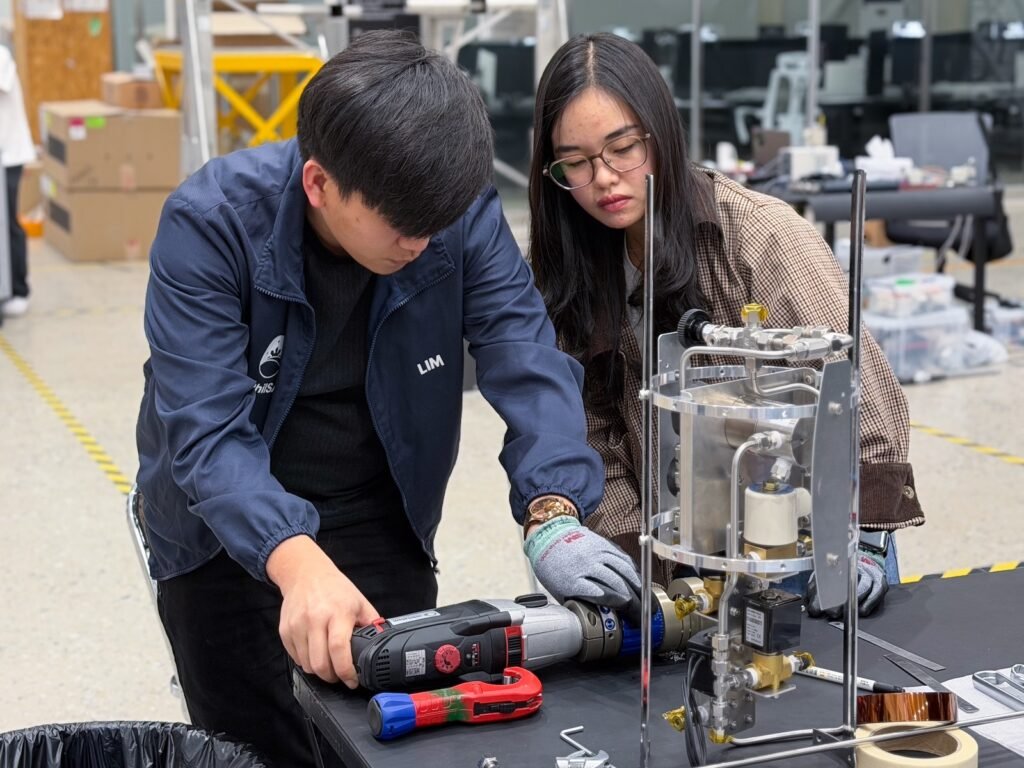
The mission is a sounding-rocket test rather than an orbital launch. PhilSA has described it as a demonstration flight aimed partly at developing local experience in rocket systems, launch operations, safety procedures, and other launch-support activities. The agency previously said it would be the first liquid-fueled sounding rocket launched from Philippine soil.
The planned launch will use infrastructure at Cagayan North International Airport. PhilSA and the Cagayan Economic Zone Authority (CEZA) are preparing the local site and conducting consultations in Cagayan, while the Department of Information and Communications Technology and Ascend International Gateway are providing connectivity and logistical support.
PhilSA sees the test as part of a longer effort to develop the technical, operational, safety, and regulatory foundations needed for future launches from the Philippines. The agency said the work could also generate information relevant to future spaceport development.
“Progressively developing our domestic launch capabilities will allow greater flexibility and independence in sending satellites into space, which serves the country’s key sectors such as security, telecommunications, and agriculture,” PhilSA Acting Director General Gay Jane P. Perez said.
Those preparations are not yet complete. A safety exclusion zone plan is still being developed, and PhilSA has not announced an exact date for the 2027 launch.